/02%20Common%20Resources/Logos/Header%20Logo-cropped.svg)

.png?width=301&height=187&name=Website%20Navigation%20Images%20(3).png)
-1.jpg?width=1984&height=1196&name=UFIT%20Club%20Street%20Front%20(4)-1.jpg)




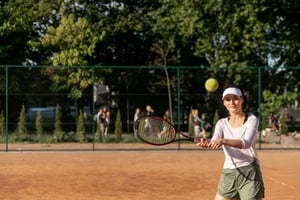
Racquet sports are booming in Singapore. Tennis, badminton, squash, and pickleball courts are packed every evening, and for good reason. These sports are fast, social, and deliver a serious full-body workout in a short amount of time.
But while racquet sports look effortless when played well, they place unique demands on the body. Rapid starts and stops, upper body plyometric movements, explosive change of direction, repeated lunges, and powerful overhead serves/smashes put constant stress on the same joints and muscle groups. Over time, this can lead to frustrating overuse injuries that slowly creep in and eventually force players off the court.
The good news is that most of these injuries are preventable. Below are five of the most common injuries seen in racquet sports enthusiasts, along with practical ways to reduce your risk and keep playing pain-free.
1. Tennis Elbow and Golfer’s Elbow
Elbow pain is a common issue for anyone who spends hours on the court. Two complaints commonly associated with elbow pain are tennis elbow, which causes discomfort on the outside of the joint, and golfer’s elbow, which affects the inside. Both result from tendon overload due to sustained gripping alongside repetitive wrist and forearm movements.
These injuries develop when the forearm muscles and tendons are repeatedly asked to handle more force than they can manage. What starts as mild discomfort after a game can quickly become a persistent sports injury that affects everyday tasks such as lifting and manipulating objects or typing.
Prevention focuses on improving strength and technique. Isometric exercises about the wrist, where the aim is to tighten the muscles in an attempt to move the wrist against an immovable object (and the joint doesn’t move) is very helpful for pain reduction during the initial phase. Eccentric forearm exercises, where you slowly lower the wrist under control, are highly effective at improving tendon resilience. Using a racquet with the correct grip size also helps reduce unnecessary strain on your forearm.
If the issue lingers or worsens, seeking treatment from a physio for elbow pain early can prevent a minor issue from becoming a long-term setback.
2. Rotator Cuff Injury and Shoulder Pain
Shoulder pain is another frequent issue, especially for players who serve or smash often. It usually presents as a dull ache or sharp pain during overhead movements, and may progress to difficulty lifting the arm or generating power.
The shoulder relies on a group of small stabilising muscles known as the rotator cuff. These muscles work overtime in racquet sports to keep the shoulder joint centred during fast, high-velocity swings. When training volume increases or recovery is poor, these muscles fatigue.
Injury prevention focuses on quality, not just quantity. Targeted rotator cuff exercises, such as external rotation, combined with scapular and mid-back strengthening, help stabilise the shoulder. Progressing range of motion through the thoracic spine and ribs also allows for a sharing of load and less rotator cuff overuse. Improving core and hip strength ensures power flows through the body efficiently, reducing strain on the shoulder.
Persistent symptoms should be addressed early by setting up an appointment with a physio for shoulder pain to avoid long layoffs from the sport.
3. Knee and Patellar Tendon Pain
Knee pain is a common hurdle for racquet sport enthusiasts thanks to all the lunging, jumping, pivoting, and sudden changes of direction on court. You might feel soreness just below the kneecap, often called jumper’s knee, or notice general stiffness and a wobbly feeling during matches.
This usually comes from overworking the quadriceps and the tendon that connects them to your kneecap, called the patellar tendon. Every explosive push-off, hard landing, and sharp lateral movement puts repeated strain on these areas. Hard court surfaces and poor landing technique can make your knees take even more of the impact, while weak hips shift extra stress onto the joint.
Preventing a knee sports injury isn’t just about avoiding pain, it’s about keeping you moving freely and confidently on court. Strengthening your glutes, hamstrings, and thigh muscles helps control knee alignment and absorb impact. Single-leg stability drills are especially useful because most racquet sport movements rely on one leg at a time.
Combine this with proper landing and deceleration technique, and you’ll feel more agile, less stiff, and ready to push your game without worrying about your knees holding you back.
4. Achilles Tendonitis and Calf Strain
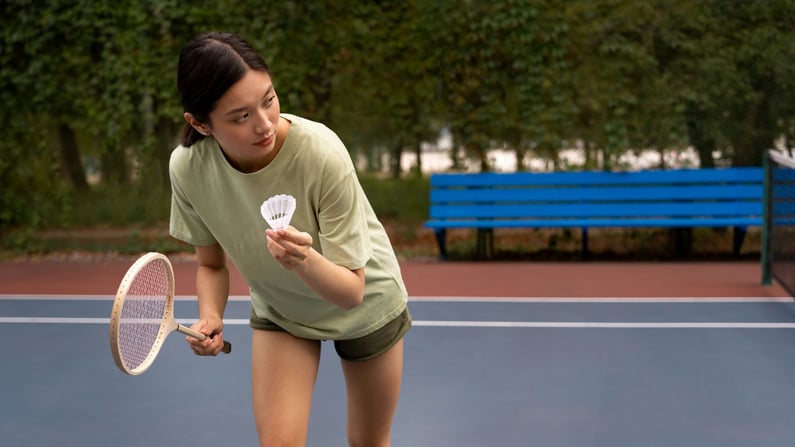
Calf and Achilles stiffness often shows up first thing in the morning or after a long session on court. For many, it begins as simple tightness and gradually turns painful if left unchecked. This is especially true for players that stay light on their toes.
All those short bursts of acceleration, rapid stops, and constant push-offs from the forefoot place repeated stress on your calf muscles and the Achilles tendon. If these muscles and tendons aren’t strong or mobile enough, they struggle to recover from the repeated load. Limited ankle mobility or worn-out court shoes can make the problem worse.
Regular stretching of your calves keeps the muscles supple, while daily ankle mobility drills improve movement efficiency and reduce strain. These should be done proactively to decrease the risk of tendonitis. Eccentric calf exercises, where you slowly lower your heel under control, are particularly effective at strengthening the tendon and reducing the risk of pain. If pain is unrelenting and severe, seek out professional physiotherapy help.
5. Lower Back and Hip Strain
Nothing kills a rally faster than a stiff lower back. Many racquet sport players notice discomfort when twisting for a serve, reaching for a drop shot, or crouching in a ready position.
The issue often comes down to how your body handles rotation. Powerful swings and sudden twists demand mobility through the hips and stability from your core. If those areas are weak or tight, your lower back ends up taking the hit, which leads to fatigue, stiffness, and sometimes more serious strain.
The solution isn’t just stretching; it’s about training smarter. Building core stability through anti-rotation exercises teaches your body to control movement under load. Meanwhile, improving hip mobility lets you generate rotation from the right places, so your lower back can stay out of the line of fire.
How UFIT Physiotherapy Protects Your Game
For racquet sport players who want to stay healthy and competitive, injury prevention is just as important as skill development.
Through sport-specific movement analysis, UFIT Physiotherapists assess how you move, load your joints, and generate power on court. This allows them to identify weak links that may be increasing your injury risk and address the root cause rather than just the symptoms.
Book a physiotherapy session in Singapore with UFIT today to get expert guidance on injury prevention and keep you moving safely on court.